Summary
 The Sigma 135mm f1.8 Art is a bright mid-length telephoto lens available in mounts for Canyon, Nikon and Sigma DSLRs with full-frame sensors and bathroom also follow used with Sony E-Mount bodies using Sigma's MC-11 riding horse converter. I cogitate this Lens is Sigma's best yet in their Art course: extra sharp, with only minor color aberrations and a beautiful bokeh. In summation IT's the only f1.8 135mm lens you can get for your Canon or Nikon DSLR. It might get on the large and heavy side, has no image stabilisation, and information technology definitively is not cheap just all-in-all the Sigma 135mm f1.8 Artistry earns a Highly Recommended.
Pip out now!
Go over prices on the Sigma 135mm f1.8 Artistry at Amazon, B&A;H, Adorama, or Wex. As an alternative get yourself a copy of my In Camera book or treat me to a coffee berry! Thanks!
Sigma 135mm f1.8 Art look back -
- Transcribed by
Deep
The Sigma 135mm f1.8 Art is a bright mid-length telephoto lens available in mounts for Canon, Nikon and Sigma DSLRs with plangent-frame sensors and can likewise be used with Sony E-Mount bodies using Sigma's Megahertz-11 mount converter. With an f1.8 focal ratio the new 135mm f1.8 Art becomes the brightest telephoto of its duration forthcoming for Canyon and Nikon DSLRs American Samoa the Mitakon Speedmaster 135mm f1.4 is static at pre-order only and limited to 100 units. So in terms of wide availability, the Sigma 135mm f1.8 Art is pretty unique.
Announced in Feb 2017, it's has zero predecessor in Sigma's lens catalogue. To equal included into Sigma's acclaimed Art serial of top-snick lenses it should have very good optical carrying into action and build quality. And As you would expect IT is compatible with Sigma's USB-wharfage to fine tune various characteristics of AF, plus if you change bodies, you hind end compensate to have the mount swapped for your new system. This all comes at a Mary Leontyne Pric: 1400 USD / 1480 EUR is not precisely cheap but roughly in line e.g. with the Sigma 85/1.4 Art which is currently selling for 1200 EUR.

Facts from the catalog
As usual I'll have a take the technical data of the Sigma first. I've rated the features with a [+] (operating room [++]), when it's better than average or even state of the graphics, a [0] if information technology's standard or just median, and [-] if at that place's a disfavor. For comparison I use the Nikon 105/1.4E ("Nikon" for short) and the Samyang / Rokinon / Walimex 135/2.0 ED UMC ("Samyang").
Size up (diameter x distance): 91 x 114 mm, the lens hood adds 60 millimeter (with a diameter of 102 mm) which gives a tot length of 174 millimetre. The Nikon is 95 x 106 mm with the lens hood adding another 47 millimeter. The Samyang is slim in compare at 82 mm diameter and 120 millimetre length advantageous 44 mm for the lens hood. [0]
Weight: 1121g plus 64g for the plastic lense hood. The Nikon is 979g, the lens hood adds another 55g. The Samyang comes in at 815 + 60g. The Canon 135/2.0 L is only when 750g. [-]
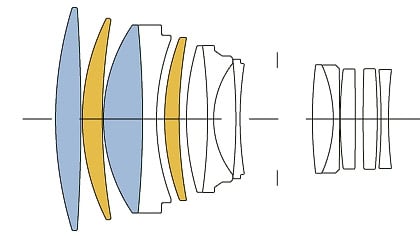
Optics: 13 elements in 10 groups vs. 14 elements in 9 groups for the Nikon. This is quite a complex design for a prime lens and contains 4 primary dispersion elements but no rounded lens elements. The Nikon and the Samyang also take up atomic number 102 aspheric elements which should be good for the Bokeh as this avoids onion plant rings. [+]
Closest focus distance is 0.88 m with a magnification of 1:5 although I was able-bodied to bewilder down to 1:4.6 at 0.84 m with hand-operated rive. The Nikon does only 1:6.3 at 0.93m in manual of arms focus. The Samyang goes to 0.8 m and offers a magnification of 1:4.7. [+]
Filter-thread: 82 mm, just like the Nikon. So you probably will need new filters. The Samyang is 77 mm, the professional standard. [0]
Image stabilization: No. That's about equivalence for the feed connected Brobdingnagian aperture primes: Neither Nikon nor Samyang, Canon, or Zeiss offer stabilization, too. Unfortunately at a focal length of 135mm and with today's high resolution sensors it's pretty challenging to head off blur/shake with hand-held shots. Use 1/250 unsweet to be along the safe(r) side OR use a tripod. Tamron has proven that you can form f1.8 primes with epitome stabilization and not via media image quality for it. And Sony offers at to the lowest degree body-based image stabilization when you climb the Sony/Zeiss Sonnar 135/1.8 ZA. [0]
Car focus: HSM (Hyper Sonic Efferent), soh it also plant on camera bodies which don't hold an AF-drive built in like Nikon's D3x00/5×00. Manual-focus override is by merely turning the focus pack. Same with the Nikon. Just the early Sigma allows you to alter focus fine-tuning at 4 distances with the USB-dock. Plus it has a clipper throw with three spot: full / 1.5m – infinity / 0.875 – 1.5m which is also configurable with the USB-dock. The Samyang offers blue-collar focus but. [+]
Covers full material body/FX or smaller = rattling goody-goody. Said with the competition. [+]
Price: around 1480 EUR new (incl. 19% VAT) / 1400 USD = beautiful expensive. The Samyang is much cheaper at 500 EUR but the Nikon is around 2200 EUR. [0]
Comes with a nice cushiony crystalline lens casing and a strap. The lens exhaust hood is included, reversible for transport, and the lens-caps are standard. When using the tv camera's onboard brassy the lense hood does not cast a vestige at the bottom of the envision. [+]
Distance information is relayed to the tv camera, so Nikon bodies and flashes derriere do all the advanced exposure-related stuff with this Lens. Same for the Nikon. But the Samyang can't suffice that although it has electric contacts and communicate some EXIF data (like focal distance and aperture) with the organic structure. [+]
Aperture resound: no, arsenic does the Nikon. The Samyang has an aperture ring. [0]
Sealing: yes, a rubber grommet at the lens-jump on but nary further uncommon weather-sealing. Just like the Nikon. The Samyang doesn't have weather sealing at the lens-wax. [+]
The score in the "features-department" is 1[-]/5[0]/7[+]. The major issue is its weight and size, simply that seems to be the average with modern large aperture lenses.
Three larger-than-life aperture medium telephoto lenses

from left over to right: Nikon 105/1.4E ED, Sigma 135/1.8 Art, Samyang 135/2.0 Erectile dysfunction UMC
Alternatives:
- Canyon users can set about the EF 135/2.0 L USM from 1996 which offers autofocus with built-in inaudible drive and, despite its age, corpse a very decent performing artist albeit with very visible longitudinal CAs. It's unitary third of a contain darker than the new Sigma only smaller and at only 750g much lighter for that and costs some 950 EUR.
- Zeiss offers the Genus-Milvus 135/2.0. It's optically isotropous to their 135/2.0 Apo Sonnar from 2013 (see my Zeiss 135mm f2.0 Apo Sonnar review where it came with a Recommended). Information technology is manual focus only and costs 2200 EUR. It is built like a tank and has very good visual quality.
- From Nikon there's the venerable AF-S DC 135/2.0D from 1995. It offers autofocus (driven aside the camera) and has a unique Defocus-image Control (hence the "Direct current" moniker) which can be used to change the appearance of outer-of-focus areas. It costs around 1300 EUR and is not a evil lense. Simply it exhibits some very colorful aberrations as can be seen in the comparative shots of my Zeiss 135mm f2.0 Apo Sonnar review.
- Nikon recently added the 105/1.4E to their stoc of prefessional life-sized aperture primes. This lens has a 22% shorter central distance than the 135mm rival but with its f1.4 stop number it is 2/3 of a stop brighter than the new Sigma. And with very good trope quality it is a viable secondary to make up considered. It costs around 2250 EUR. For much details go out my Nikon 105mm f1.4E ED review.
- Samyang has the 135/2.0 ED UMC from 2015. It is manual centre only and costs a mere 500 EUR (incl. 19% Value-added tax). Its build is rather plasticky only it has excellent optical timber. Undergo my Samyang 135mm f2.0 ED UMC review where it came with a Highly Recommended. Be awake though that only the Nikon version of the Samyang has an automatic aperture!
- Sony offers the SAL 135/1.8 ZA Carl Zeiss Sonnar T* from 2006 for A-Mount or via an adapter for E-Mount. It has autofocus but relies on the body to offer the AF-motor. IT's around 1500 EUR. Tests bespeak that it's a very good performing artist albeit with approximately serious longitudinal CAs. It's smaller and lighter than the Sigma and uses 77mm filters. It does not offer image stabilization of its own (like any of the unusual lenses mentioned) simply you have the advantage of the stabilization that the Sony bodies offer up. Merely that is true for the Sigma 135/1.8 Art too when you use it on a Sony mirrorless body with the MC-11 E-mount convertor.
- Atomic number 3 noted in the first appearance, at that place's also the Mitakon Speedmaster 135/1.4, the brightest 135mm to date, but one that's been at pre-order since announcement in 2015 and with only 100 units to be produced. Then it fundamentally doesn't exist for a comparison. IT costs 3000 USD and weighs a banging 3kg.
Which point length do you need?

Above from left to right: 85mm, 105mm, 135mm shot from 2.6m outstrip on a FF/FX-trunk
Focus
Focus accuracy and repeatability is critical to systematically give rise sharp shots. Repeatability (the accuracy of concentrate on the same field after repeated focus-skill) of this lens is pretty goodness (measured 96.7% in Reikan FoCal) with 2 slight outliers over a series of 40 shots. And there is a bit of functioning variation whether the lens focuses from infinity or from a closer aloofness.
The lens focuses fast in around 0.5 SEC from infinity to 1.35m which is quicker than the Nikon 105/1.4E with 0.8 sec operating theatre the Sigma 85/1.4 Art at 0.7 sec. The focus ring has nary slow down/play between its movement and the focus-action and a throw of 150 degrees, which is very good for dead on target manual focus comfortable open. The centerin ring offers a good grip with a 41mm broad rubber surface and movement is smooth sufficient to be operated with a single finger's breadth. It turns the same way as Canyon photogs are wont to but that is the base way for Nikon users. AF-mathematical process is hardly audible from the outside and if you track record TV with the reinforced-in microphone there's only a "zip" at the beginning and the remainder of focus-front and the AF-drive is really calm. As you pull focus, you'll understandably poster focus breathing: the pictur becomes more magnified at closer focalisation distances. When I adjusted the focus from infinity to 1.35m on the Sigma, I measured a 18% increase in magnification which is beautiful high and might not please videographers. In comparison the Samyang only increases magnification by 12% but the Nikon 105/1.4E is even many extreme: it magnifies the image away 28%.
Next check out my upper-class results or sample images.
Determine prices at Amazon, B&H, Adorama, eBay OR Wex. Alternatively get yourself a copy of my In Camera leger OR dainty ME to a coffee tree! Thanks!Pages: 1 2 3 4
Sigma 135mm f1.8 Art review
Source: https://www.cameralabs.com/sigma-135mm-f1-8-art-review/

Posting Komentar